

 NAVER Booking
When shoulder pain persists for a long time, you hear various explanations. Shoulder impingement syndrome, subacromial bursitis, rotator cuff injury, calcific tendinitis, frozen shoulder, degenerative changes, and more.
Examinations and imaging tests are important clues for understanding the condition of the tissues. However, changes seen on imaging do not always correspond directly with current pain. Because rotator cuff changes are also observed in shoulders without pain, imaging findings must be interpreted alongside actual symptoms and clinical examination results.[1]
If pain remains even after treatment, it is necessary to reassess the recovery status of the diagnosed tissues, movement and muscle strength, and the way the arm is used in daily life. In that process, the condition of the arm and hand connected to the shoulder can also become subjects of examination.
Much Improved, Yet Residual Shoulder Pain Remained
There was a patient who had been continuing treatment for chronic shoulder pain. The patient had been diagnosed with a rotator cuff injury.
As moxibustion treatment was applied around the shoulder, the pain improved considerably. However, some discomfort still remained.
While examining the remaining symptoms, the scope of examination was broadened toward the palm. A manual release procedure was applied to the soft tissues around the muscles and tendons of the palm. Immediately after the procedure, the shoulder pain was substantially reduced.
This response serves as a clue regarding what more to look into during subsequent visits. It is necessary to monitor progress to see whether the improvement is maintained when the arm is used again in daily life, and what discomfort remains.
In connection with this treatment session, let us examine the fascial connections of the arm and the Golgi tendon organ, which senses muscle tension.
How Are the Shoulder and Hand Connected?
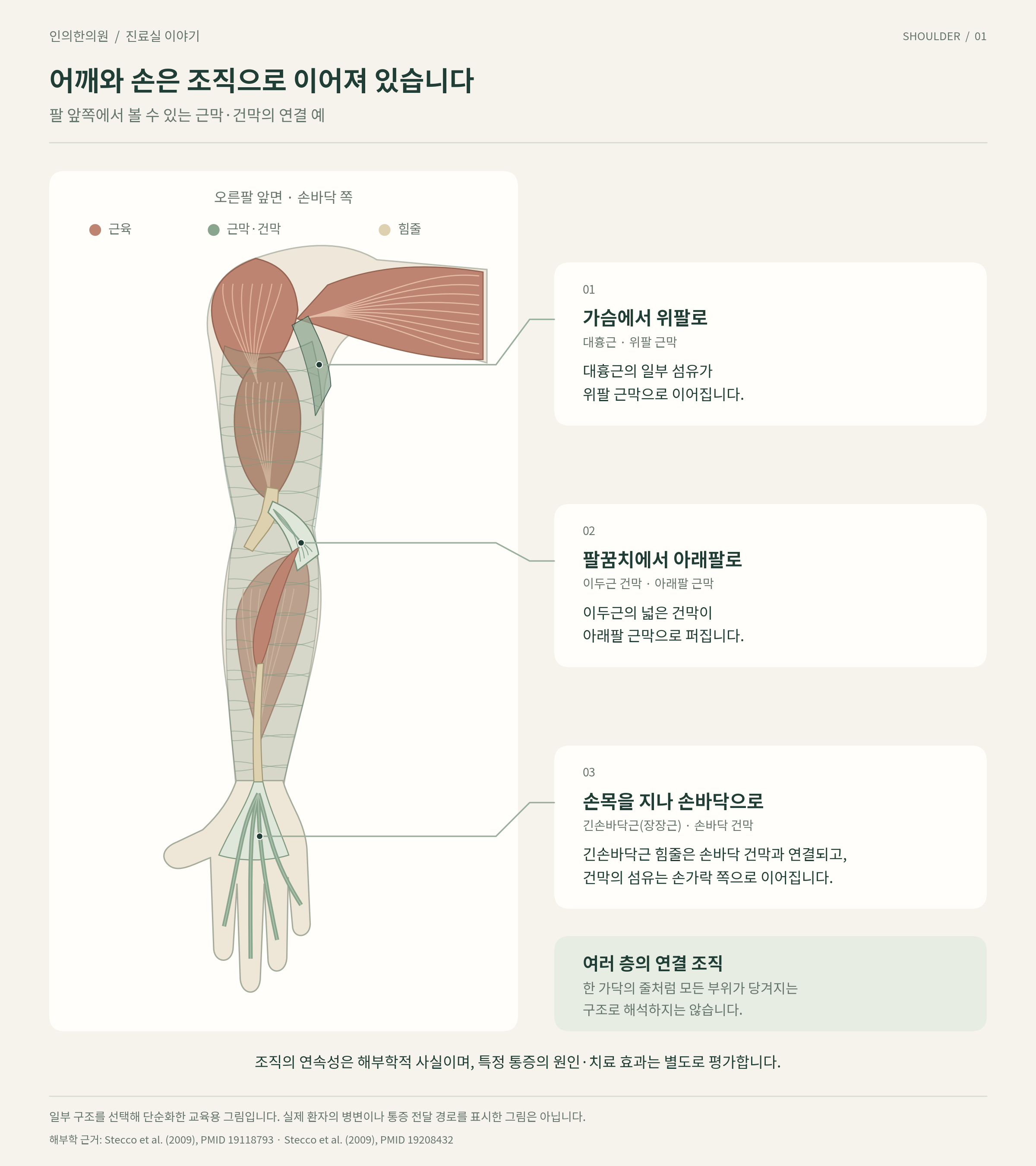
Click the image to view it larger.
Fascia is connective tissue that envelops muscles, divides between muscles, and connects with surrounding tissues. Broad, flattened tendon-like structures are called aponeuroses.
In anatomical studies of the arm, connections are identified where some fibers of the pectoralis major continue into the brachial fascia, and the broad aponeurosis of the biceps spreads into the antebrachial fascia. The tendon of the palmaris longus in the forearm connects with the palmar aponeurosis.[2,3]
One perspective that understands these connections of muscles and fascia as continuous pathways is anatomy trains (myofascial meridians). Because real connections in the body are formed in multiple layers, rather than thinking of it as a single tight cord stretching from the shoulder to the fingertips, it is better understood as interconnected tissues moving together.
These connections provide an anatomical reason to broaden the scope of examination not only to the area around the painful site, but also to the arm and hand. However, the mere fact that tissues are connected does not uniquely determine which area is the cause of the pain, nor the precise pathway through which treating the palm influenced the shoulder.
What Does the Golgi Tendon Organ Do?
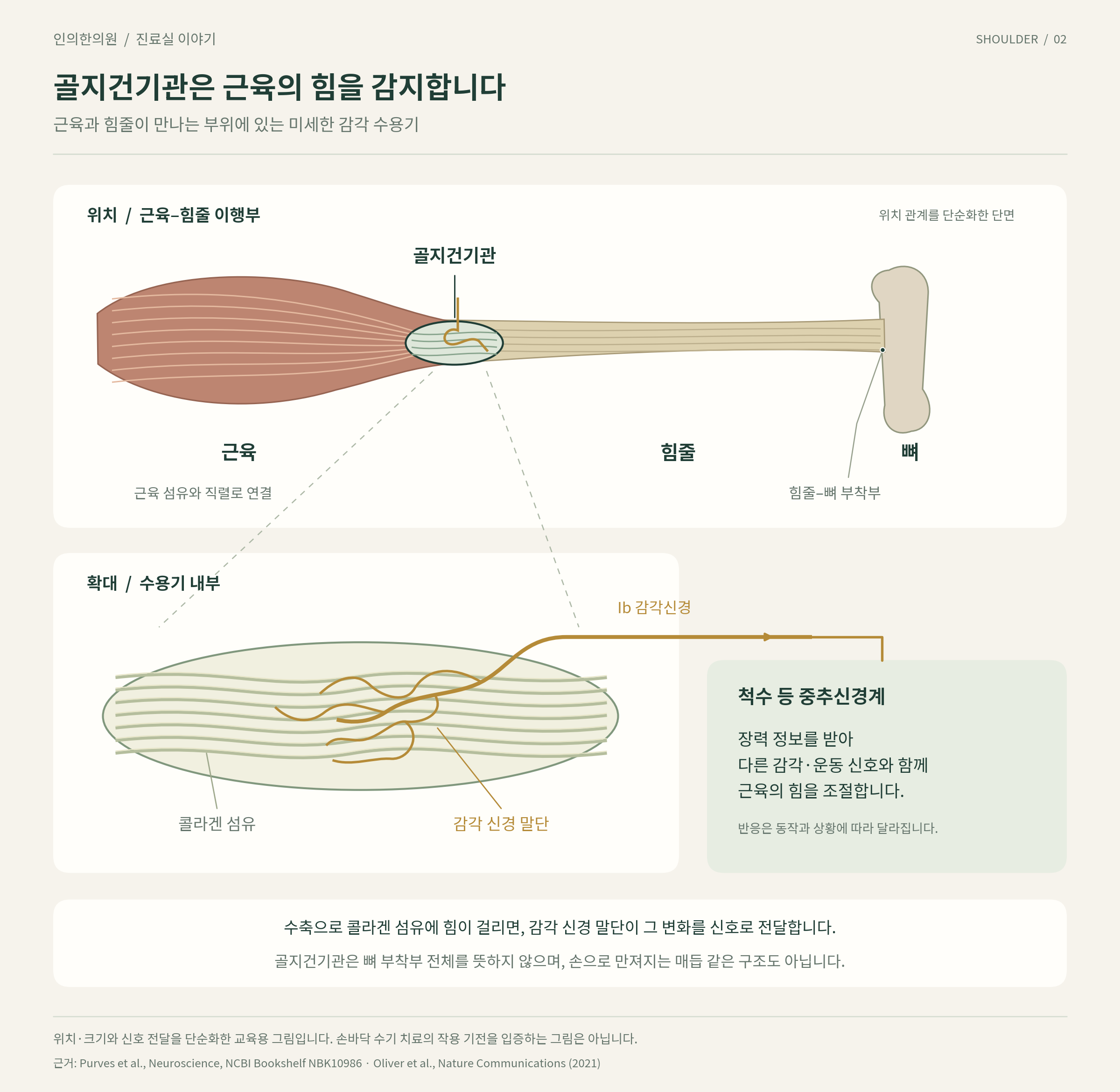
Click the image to view it larger.
The Golgi tendon organ is a microscopic sensory receptor mainly located at the junction where muscle meets tendon. It senses changes in the force produced by muscle, namely tension.[4,5]
When a muscle contracts, force is transmitted toward the tendon. At this time, force is exerted on the collagen fibers inside the Golgi tendon organ, and the sensory nerve endings interwoven among them sense the change. This information is transmitted through group Ib sensory afferents to the central nervous system, including the spinal cord, and is used to regulate muscle force and movement.[4,5]
The Golgi tendon organ does not mean the entire area attaching to the bone, nor does it refer to a hard knot that can be felt by hand. The target released by hand in this clinical session is the soft tissue around the muscles and tendons on the palmar side. The action of a specific Golgi tendon organ cannot be confirmed solely from the response that pain has decreased.
Carrying Forward Changes in Pain to the Next Examination
The response that shoulder pain decreased after addressing the area around the palm is a meaningful observation. However, there are multiple possibilities for the reason, such as changes in tissue tension or sensory input, and temporary fluctuations in pain must also be considered together. A reduction in pain and the recovery of the rotator cuff injury itself are examined distinctively.
An approach that examines fascia and soft tissues is one aspect that can be considered in evaluating chronic shoulder pain and establishing a treatment plan. Depending on the examination results, shoulder joint movement, rotator cuff function, neck and scapular movement, muscle strength, and the burden of use in daily life are also checked together.
Afterward, it is necessary to check how the pain is when trying the uncomfortable movement again and whether the change is maintained in daily use. If the improvement is only brief or if the same discomfort repeats, the diagnosis and treatment plan are reviewed again.
INI Korean Medicine Clinic continues examination from the discomfort that remains right now. Along with where it hurts, we look at which movements cause discomfort and what changes after treatment, determining the direction of the next treatment.
References
[1] Ibounig et al. Incidental Rotator Cuff Abnormalities on Magnetic Resonance Imaging. JAMA Internal Medicine. 2026. — A cross-sectional study comparing imaging findings with symptoms in 602 Finnish adults aged 41 to 76 years. It is evidence for interpreting imaging findings alongside symptoms, and does not mean that an individual patient's injury is unimportant.
[2] Stecco et al. Anatomical study of myofascial continuity in the anterior region of the upper limb. 2009. — An anatomical study confirming the fascial continuity in the anterior aspect of the arm. It shows the connection of tissues and is not a study verifying the effect of palm treatment on improving shoulder pain.
[3] Stecco et al. The palmaris longus muscle and its relations with the antebrachial fascia and the palmar aponeurosis. 2009. — An anatomical study describing the relationship between the palmaris longus tendon, the antebrachial fascia, and the palmar aponeurosis. There are individual variations in the presence and morphology of the palmaris longus.
[4] Purves et al. Neuroscience — Other Afferent Feedback that Affects Motor Performance. — A neuroscience textbook describing the location of the Golgi tendon organ, tension sensing, and motor control based on sensory information.
[5] Oliver et al. Molecular correlates of muscle spindle and Golgi tendon organ afferents. Nature Communications. 2021. — A basic mouse study distinguishing sensory nerves of muscle spindles and Golgi tendon organs. It is material for understanding the structure and function of the receptors and does not demonstrate the effect of human palm manual therapy.
The illustration is a newly drawn educational schematic to explain anatomical locations and connections. It is not an actual patient's imaging or a comparison picture before and after treatment, and tissue sizes and proportions have been simplified for explanation.