
A patient came to visit, saying that a pulling, tight sensation was felt whenever bending the wrist. It was a pain that had lasted for several days. The patient said no particular injury or excessive strain came to mind.
Upon checking movement, pain appeared on the back of the hand during the motion of bending the wrist toward the palm. Even with the same wrist pain, distinguishing in which direction movement occurs and which area hurts is the starting point of an examination.
In this clinical visit, attention was paid to the movement of the small joints that make up the wrist. Corrective treatment was performed on the wrist joints, and acupuncture and moxibustion treatments were applied around the joints. After treatment, the pain almost disappeared.
However, this is a change confirmed immediately after treatment. It still needs to be checked a bit further whether it remains comfortable when using the wrist again in daily life, and whether the pain does not recur.
The wrist does not move like a single hinge
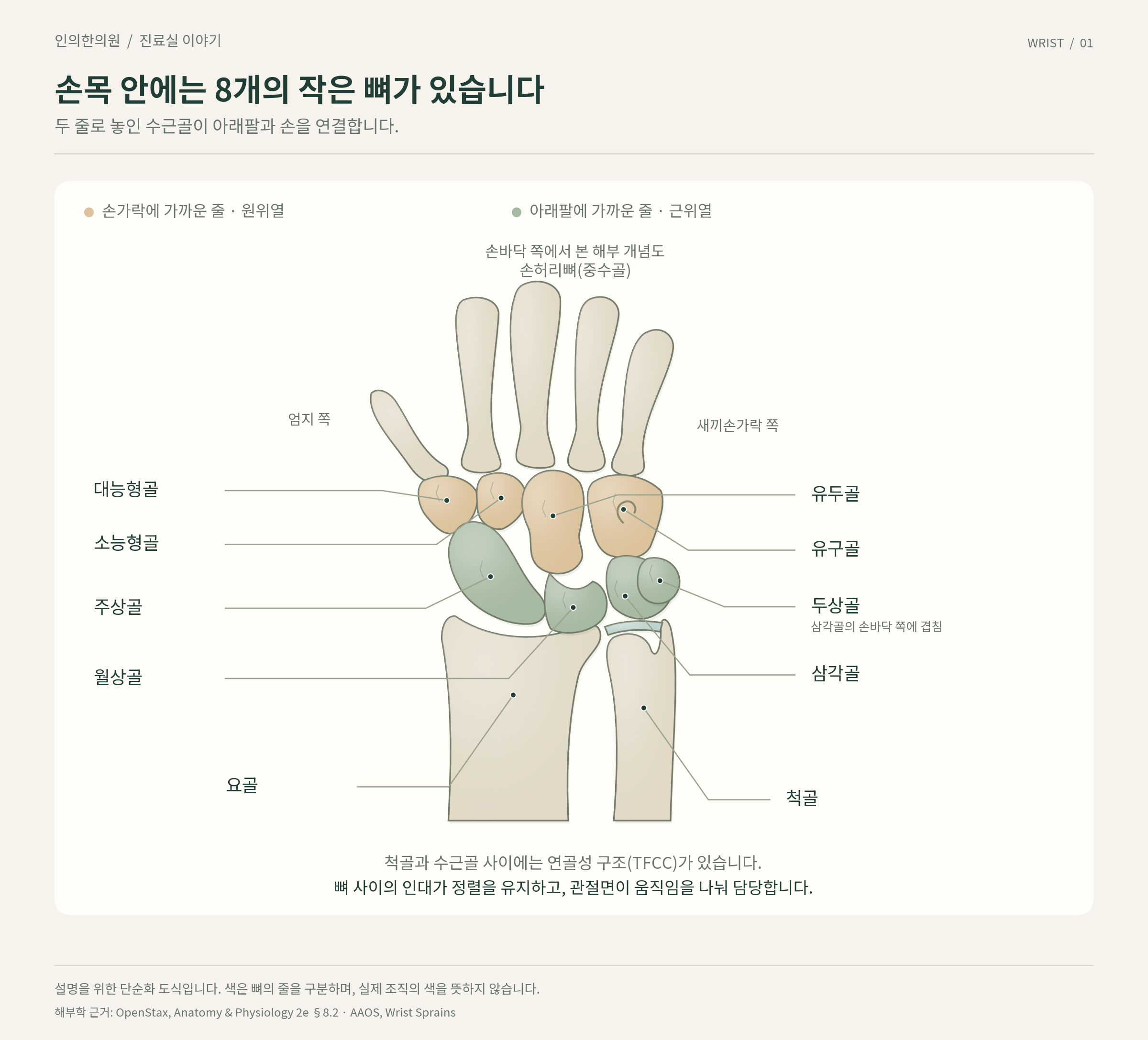
In the wrist, there are 8 small bones called carpal bones arranged in two rows. These bones connect between the bones of the forearm and the metacarpal bones, and multiple ligaments maintain the relationships between the bones. The wrist is not a structure where a single mass of bone bends at one single point.[1]
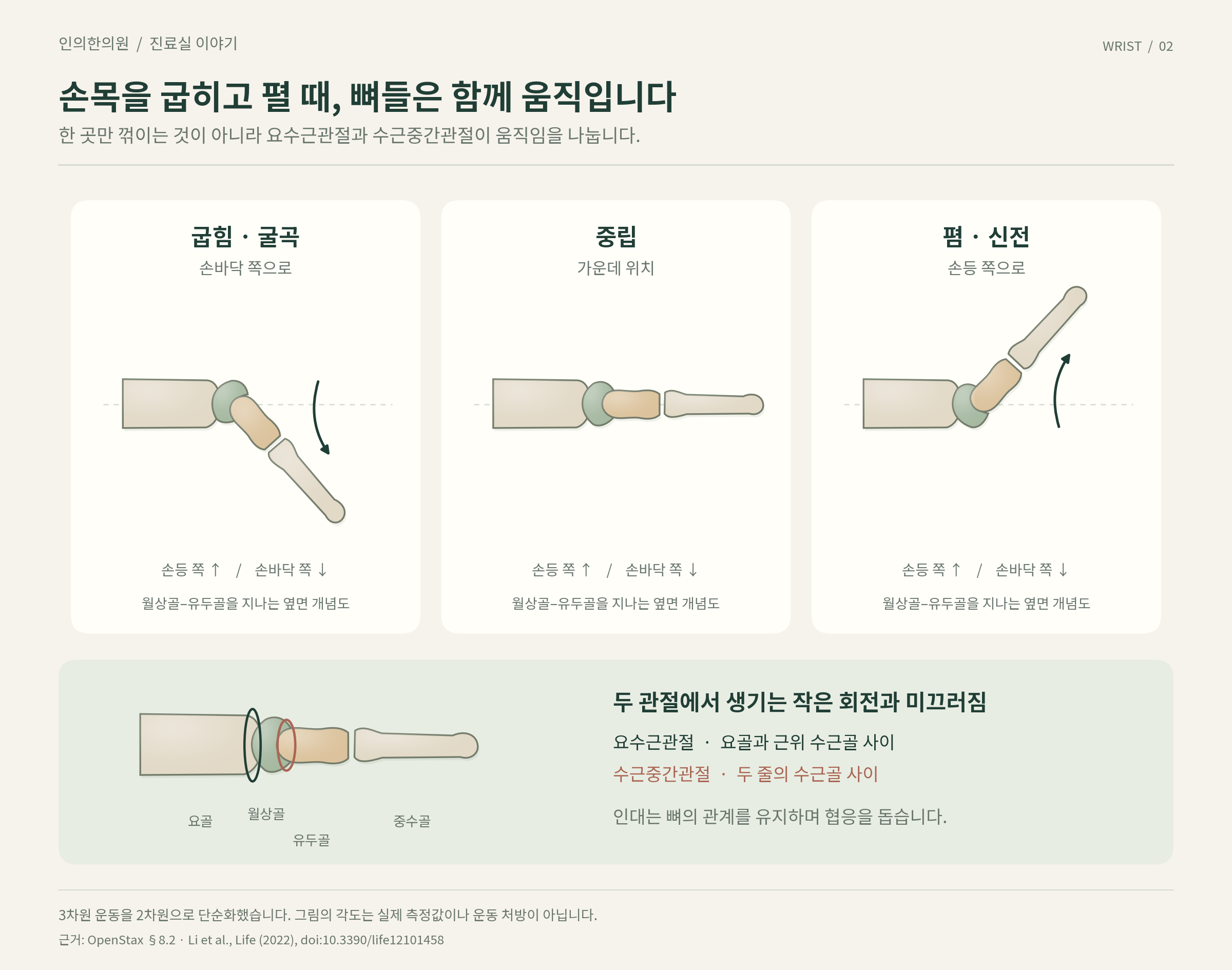
When bending and extending the wrist, the joint between the forearm and the carpal bones, as well as the joint between the two rows of carpal bones, move together. The bones rotate and translate slightly relative to one another, and rolling and gliding occur at the articular surfaces. These small movements combine to create the movement of the entire wrist.[1,2]
Therefore, when examining the wrist, one checks not only the painful area, but also in which direction movement is uncomfortable, along with the condition of the surrounding tissues.
Can it hurt if the alignment of the joints is disrupted?
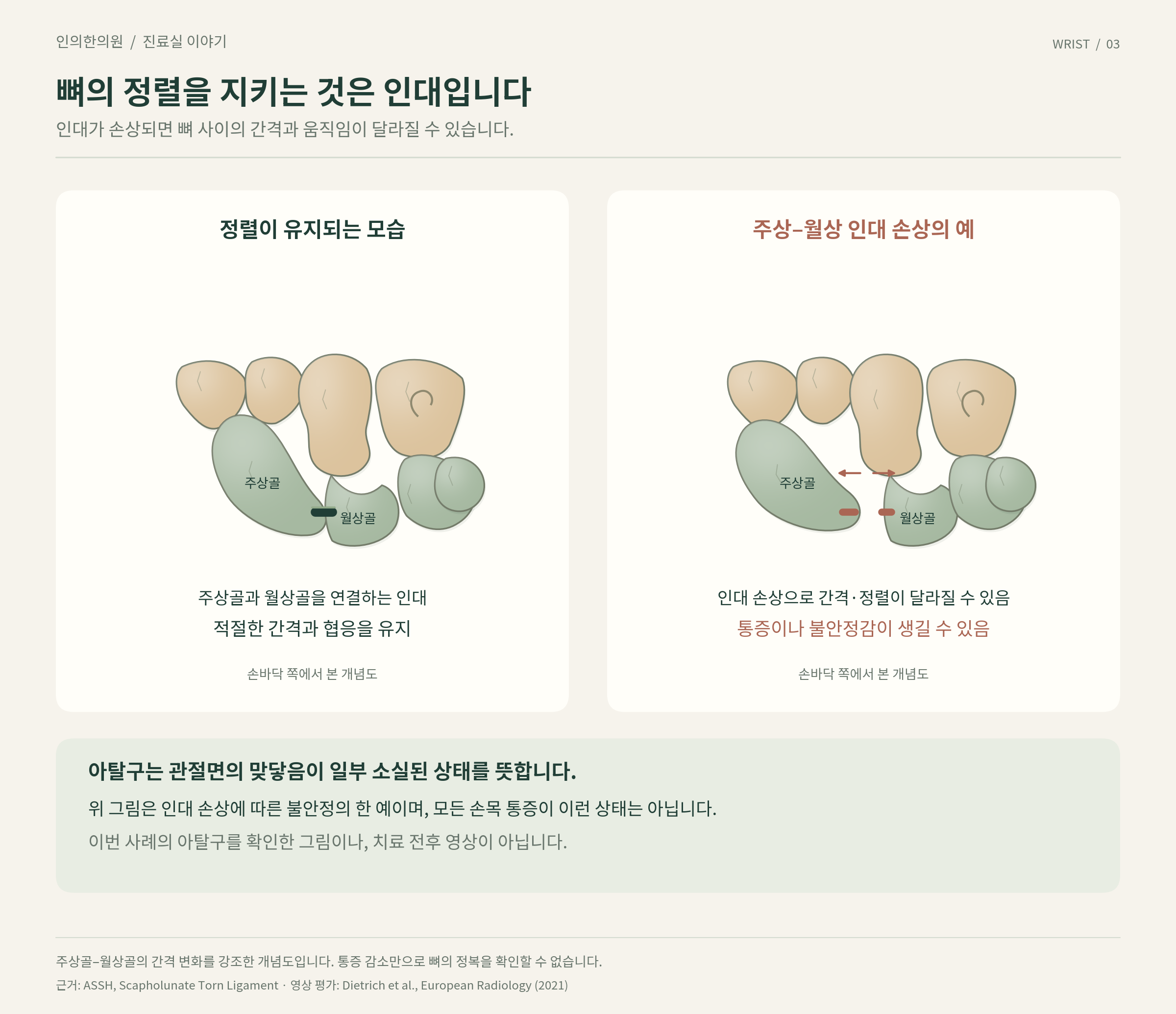
When the ligaments connecting the wrist bones are injured, the spacing or movement between the bones changes, and pain or a sense of instability may arise. The illustration above is an example explaining a case where the ligament between the scaphoid and lunate bones is damaged.[3]
Subluxation refers to a state in which contact between the articular surfaces is partially lost. However, it cannot be concluded as subluxation solely from the symptom of hurting when bending the wrist. Because wrist pain can also appear from other causes such as problems with tendons or joint capsules, it must be differentiated through clinical examination and, if necessary, imaging tests.[3,4,5]
What was confirmed in this case is the change that the pain almost disappeared after treatment. That response alone does not confirm subluxation of a specific bone, nor does it prove that the bone has returned to its proper position. A process of checking whether improvement is maintained during the same motion and in routine daily use thereafter is necessary.
If you have long-standing wrist pain
If the wrist is stiff and uncomfortable, first reduce uses that induce pain, and try moving slowly within a pain-free range. If pain worsens or new symptoms appear even during light movements of bending and extending the wrist, it is advisable to stop.[6]
Do not try to set the bones yourself by pulling the wrist forcefully or bending it to the end. For long-lasting or recurring pain, it is advisable to confirm the cause first and then select exercises or treatment appropriate for the condition. When there is severe swelling or a change in shape after an injury, or when numbness or loss of strength is accompanied, please seek medical care.[3,6]
The wrist is an area where small joints work together. We will examine step by step where it hurts, how it hurts when moving, and how that same movement changes after treatment.
References
[1] OpenStax, Anatomy & Physiology 2e, 8.2 Bones of the Upper Limb — Anatomy textbook describing the composition of carpal bones and articular relationships.
[2] Li et al. Wrist Bone Motion during Flexion-Extension and Radial-Ulnar Deviation: An MRI Study. Life. 2022;12:1458 — In vivo MRI kinematic study analyzing bilateral wrists of 5 individuals. This serves as material to understand normal motion and does not prove the diagnosis or treatment effect of this case.
[3] American Society for Surgery of the Hand, Scapholunate Torn Ligament — Society patient resource explaining scapholunate ligament injury, pain, instability, and evaluation.
[4] Dietrich et al. Interdisciplinary consensus statements on imaging of scapholunate joint instability. European Radiology. 2021 — Expert consensus on the imaging evaluation of suspected scapholunate instability.
[5] American Society for Surgery of the Hand, Tendinopathies and Occult scapholunate ganglion: A cause of dorsal radial wrist pain — Materials concerning wrist tendon issues and other causes of dorsal wrist pain. Not used to present individual patient causes or general proportions by cause.
[6] NHS, Wrist pain and NHS inform, Exercises for wrist, hand and finger problems — Patient guidance regarding gentle movement and stopping if symptoms worsen.
The illustration is an explanatory diagram newly drawn based on the anatomical facts from the materials above. It is not an actual patient's image, diagnostic result, or a pre- and post-treatment comparison image. Angles and spaces have been simplified for explanation and are not actual measured values.