
Calculating My Symptom Score (ICSI/ICPI) and Setting a Management Plan
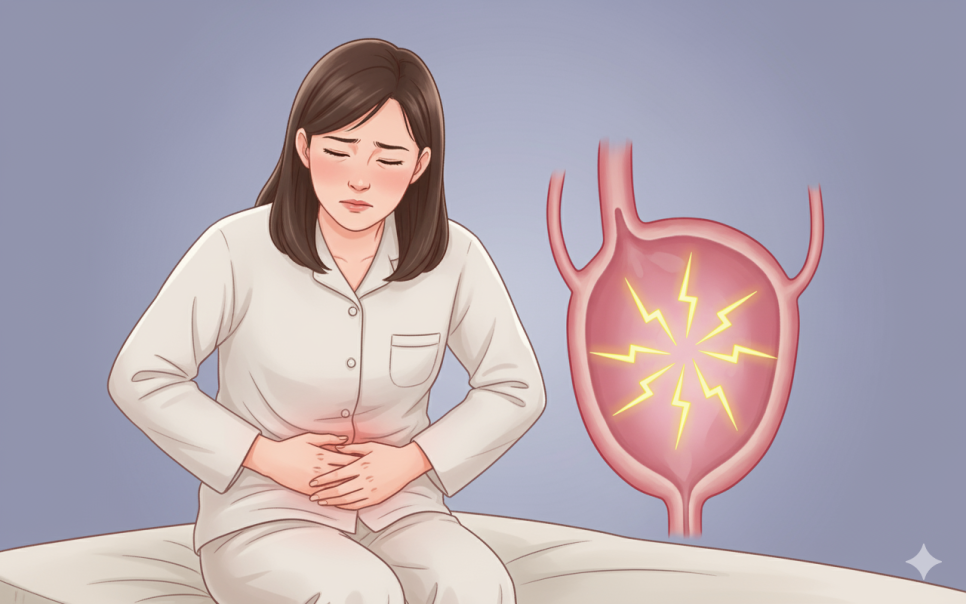
You clearly feel discomfort when urinating and a stabbing pain in your lower abdomen, but did the hospital tests tell you "there is nothing particularly abnormal"? It must have been frustrating and difficult.
This article was created to help those suffering from Bladder Pain Syndrome (BPS) check their symptom levels at home on their own and get a direction on how best to manage them going forward. (It cannot replace a hospital diagnosis!)
** Questionnaire for consultation:**https://forms.gle/q7oYCTbusHekoe3YA
** Important! Check this first** If you have urine mixed with blood (hematuria), high fever, or unbearable flank pain, before reading this article, you must first visit a nearby urology department to receive care.
✍ Done in 1 minutes! How to use the self-check
- Scoring: Read the questions below and choose the number that matches your condition.
- Adding up: Add up the 'Symptom Score (ICSI)' and 'Problem Score (ICPI)' separately to calculate the total scores.
- Checking results: Check your results in the "What does my score mean?" section at the bottom, and get tips on what you might start doing today.
- Observing changes: It is most important to check again 2 weeks later to observe how your body is changing!
IC (Interstitial Cystitis) Self-Assessment Score Sheet (ICSI/ICPI)
1. How severe are my symptoms? (Symptom Score ICSI, 0–20 points)
For each question, assign a score from 0 points to 5 points, and then add them all together.
(0 points: Not at all / 1 points: Very slightly / 2 points: Occasionally / 3 points: Moderately / 4 points: Frequently / 5 points: Very severely)
- Do you feel a frequent urge to urinate during the day? (0–5 points)
- Is it uncomfortable because you urinate too frequently? (0–5 points)
- Is it uncomfortable because you wake up at night to urinate? (0–5 points)
- Do you feel pain or a burning sensation in your lower abdomen or around the urethra? (0–5 points)
** Total My Symptom Score (ICSI): ____ points**
2. Daily life, how uncomfortable is it? (Problem Score ICPI, 0–16 points)
For each question, assign a score from 0 points to 4 points, and then add them all together.
(0 points: No problem at all / 1 points: A little / 2 points: To some extent / 3 points: A lot / 4 points: Very large)
- Overall, how much do the symptoms mentioned above bother you? (0–4 points)
- How much do you feel your quality of life has decreased because of these symptoms? (0–4 points)
- To what extent do you feel "Oh, I really need treatment"? (0–4 points)
- How long do you feel these uncomfortable symptoms have lasted? (0–4 points)
** Total My Problem Score (ICPI): ____ points**
3. It is even better if you record these together!
If you also make a note of the contents below, it will be of great help in assessing your condition more accurately and during consultations.
- Pain severity (0–10 points): If your worst pain is considered 10 points, what is your score right now? (__ points)
- Nighttime urination frequency: How many times do you wake up at night to urinate? (__ times)
- Daytime urination frequency: How many times do you usually urinate during the day? (__ times)
- Things that have bothered me recently (check all that apply): - ## [ ] Caffeine such as coffee or green tea - ## [ ] Carbonated drinks, spicy and salty food - ## [ ] Suddenly drinking too much water or drinking almost no water - ## [ ] Having fitful sleep or working overtime - ## [ ] Around the menstrual period - ## [ ] Stress, anxiety - ## [ ] Sitting for a long time - ## [ ] Other: ________
What Does My Score Mean? (Results & Next Steps)
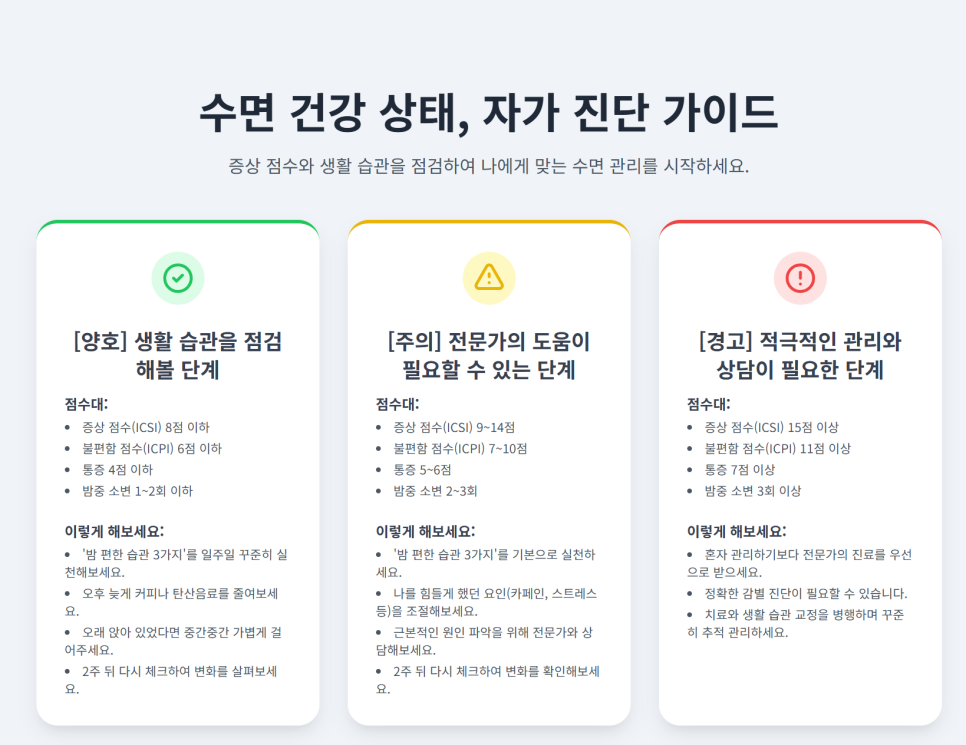
This score is not a diagnosis, but reference material for creating future management plans. It may vary from person to person.
A) [Good] A stage to review lifestyle habits
- Score range: Symptom score (ICSI) 8 points or lower, problem score (ICPI) 6 points or lower, pain 4 points or lower, nighttime urination 1–2 times or fewer
- Try this: - Try practicing the '3 Night-Comfort Habits' (adjusting water intake timing after dinner, warm compress before sleep, comfortable abdominal breathing) consistently for just one week. - ## Try reducing the habit of drinking coffee or carbonated beverages late in the afternoon. - ## If you have been sitting for too long, stand up from time to time and take light walks. - ## Check again after 2 weeks to observe the changes!
B) [Caution] A stage where professional help may be needed
- Score range: Symptom score (ICSI) 9–14 points, problem score (ICPI) 7–10 points, pain 5–6 points, nighttime urination 2–3 times
- Try this: - While practicing the '3 Night-Comfort Habits' as a base, choose one or two factors that have bothered you (such as caffeine or stress) and try to regulate them. - It is recommended to consult a professional to check your body's autonomic nervous system balance and tension around the pelvis together, and to find the underlying causes. - ## Check again after 2 weeks to see which efforts suited your body well.
C) [Warning] A stage where active management and consultation are needed
- Score range: Symptom score (ICSI) 15 points or higher, problem score (ICPI) 11 points or higher, pain 7 points or higher, nighttime urination 3 times or more
- Try this: - ## Rather than managing it alone, prioritize receiving care from a professional so that the most uncomfortable symptoms can be reduced quickly. - ## Accurate differentiation may be needed to determine whether it is a simple urinary tract infection or interstitial cystitis. - It is important to track your body's responses consistently at intervals of 2 weeks while combining treatment with lifestyle habit correction.
✨ Tailored Management Tips by Score Type
▶︎ If you wake up frequently at night due to urination: Start with the 'Night-Comfort Habits' by reducing fluid intake after 7 PM, applying a warm compress to the lower abdomen before sleep, and practicing abdominal breathing.
▶︎ If lower abdominal pain is particularly severe: Keeping the lower abdomen always warm and doing stretches that gently relax the muscles around the pelvis may be helpful.
▶︎ If the bother/problem is noticeably greater than the symptoms (ICPI > ICSI): Stress or anxiety can make symptoms feel more severe. Breathing techniques that put the mind at ease or regular lifestyle habits may be helpful.
▶︎ If specific triggers like coffee or stress are distinct: Try avoiding that factor for 2 weeks and test whether symptoms truly improve.
Frequently Asked Questions (Q&A)
Q. Is it fine if the score is low?
A. Even if the score is low, it can change at any time depending on your condition. Do not let your guard down; it is important to check steadily at 2-week intervals and maintain good lifestyle habits.
Q. Must I receive treatment if the score is high?
A. The score is only reference data, and the extent of discomfort felt varies from person to person. However, if the score came out high, rather than suffering alone, consulting with a professional is recommended so that you can resolve the most difficult symptoms first.
Q. Are the numbers the only important thing?
A. Numbers are merely a tool to objectively view changes in your body. What is more important is correcting the fundamental imbalances of your body (coldness in the body, stress, circulation of qi and blood, etc.). Through Korean medicine examination, you can find the real solution suited to your body.
Notice and Precautions
This text is intended for health information purposes and cannot replace medical diagnosis. Results may vary depending on individual condition. In the case of bloody urine, high fever, or severe flank pain, please be sure to seek hospital medical care first.
Bladder Pain Syndrome (BPS)****Information :https://blog.naver.com/inimedi8/224020647759
Recommended Night Routine:https://blog.naver.com/inimedi8/224021567871
Reservations/Inquiries:https://pf.kakao.com/_RByNT