
A patient urgently visited the clinic, reporting a sudden headache and dizziness. The patient stated that it had started two hours earlier and continued to feel dizzy even in the consultation room.
Before the symptoms began, the patient experienced an upsetting incident at the workplace. After listening to the account, the pulse was examined. Based on the pulse at that time and the clinical examination findings, it was assessed in Korean medicine terms as an aspect of Liver Heat affecting the eyes.
The area of the Qimen acupoint on the Liver Meridian was released manually.
Immediately after the procedure, the patient reported that the dizziness had resolved. A changed response compared to before the procedure was also confirmed in the pulse. The patient returned to work.
Further observation is needed to see whether the symptoms recur after this treatment or if the improved state is maintained. It was decided to check the progress during this period at the next consultation.
In connection with this consultation, we briefly introduce the relationship between the eyes and dizziness, as well as the pathway of the Liver Meridian of Foot-Jueyin and the location of the Qimen acupoint.
How Are the Eyes and Dizziness Connected?
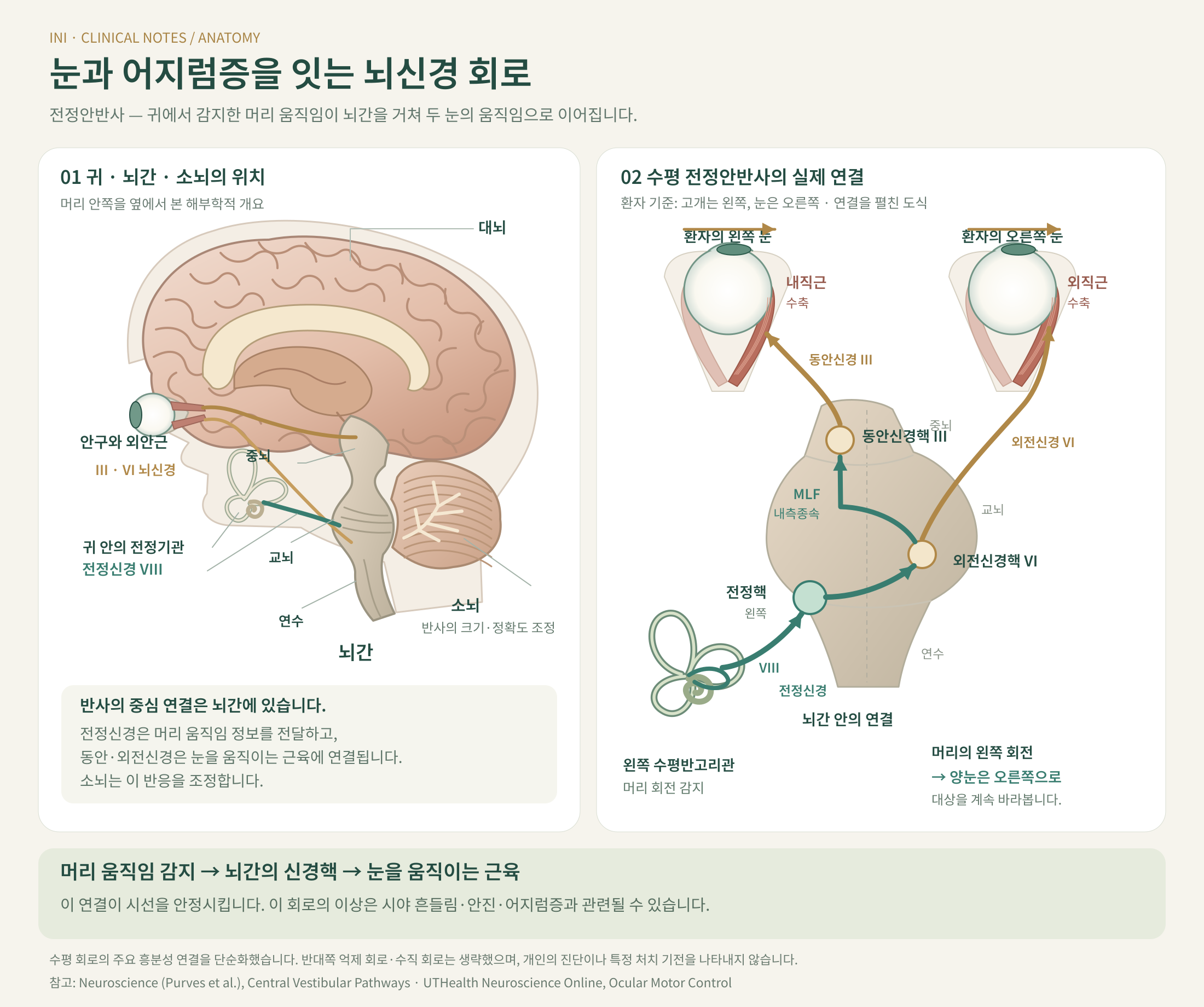
Body balance is not maintained by the vestibular organ inside the ear alone. The brain jointly processes the surrounding view seen by the eyes, the head's movement and tilt detected by the vestibular organ, and the body's position conveyed by the muscles and joints. If a problem occurs in the transmission, integration, or regulation of this information, dizziness or an unstable sensation may appear.
The eyes and the vestibular organ are also connected through the vestibulo-ocular reflex. When the head turns in one direction, the eyes move in the opposite direction, allowing stable fixation on the object being viewed. This reflex plays an important role in enabling one to see the surroundings relatively clearly even while walking.
Therefore, eye movements and the sense of balance are related to each other. However, because the causes of dizziness are diverse, the cause is not determined solely based on the relationship with the eyes.
Pathway of the Liver Meridian of Foot-Jueyin and the Qimen Acupoint
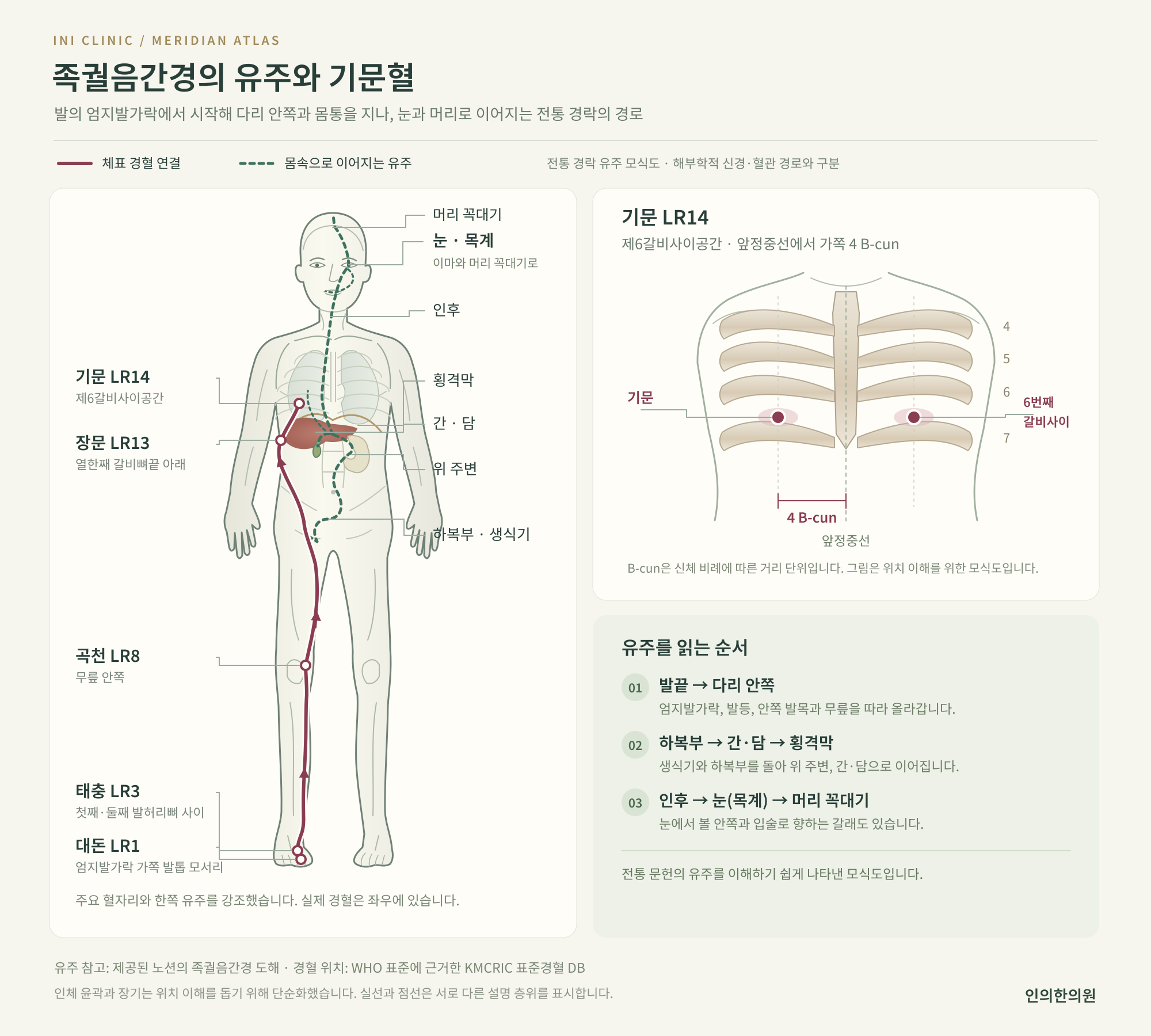
Pathway refers to the route along which a meridian runs through the body. In traditional Korean medicine, the Liver Meridian of Foot-Jueyin is described as originating from the big toe, passing through the dorsum of the foot, the inner side of the leg, and the lower abdomen, and connecting to the Liver and Gallbladder. Internally, it passes through the diaphragm, hypochondrium, and throat, connects to the eye system (Mokgye)—the region linking to the eyes—and ascends to the forehead and vertex. Branches continuing from the eye system toward the cheeks and lips, and from the Liver toward the Lungs, are also described.
Qimen (LR14) is an acupoint in the chest region belonging to this Liver Meridian. The standard location is in the sixth intercostal space on the anterior chest, 4 cun lateral to the anterior median line. Here, 'cun' is a unit of acupoint location based on body proportions.
The neurological illustration above explains the function of balance regulation, while the meridian illustration explains the Korean medicine background referenced during this examination. A meridian diagram is not a drawing depicting anatomical pathways of nerves or blood vessels, and a specific mechanism of action for the Qimen acupoint procedure cannot be confirmed by this case alone.
When dizziness occurs suddenly, sit or lie down in a safe place to rest. If it is accompanied by slurred speech, weakness in an arm or leg on one side, or a sudden severe headache, seek help immediately at 119. These symptoms require evaluation even if they improve temporarily.
References
U.S. National Library of Medicine MedlinePlus — Balance Tests: General information regarding the sense of balance and the vestibulo-ocular reflex.
UTHealth Neuroscience Online — Vestibular System: Pathways and Reflexes: University neuroscience educational material explaining the connections among the vestibular nerve, brainstem, oculomotor nerves, and cerebellum.
Purves et al., Neuroscience — Central Vestibular Pathways: Explanation of the neural nuclei and ocular muscle connections of the horizontal vestibulo-ocular reflex.
Korean Medicine Convergence Research Information Center KMCRIC — Standard Acupuncture Point DB, LR14 Qimen: The affiliated meridian and standard location of the Qimen acupoint.
Hyun-jong Jung, A Study on the Names of Each Part of the Head and Face in the Description of Meridian Pathways in 『Lingshu·Jingmai』, 2010: Interpretation of classic meridian pathways and eye system (mok-gye)-related terminology.
『Yizong Jinjian·Cijiu Xinfa Yaojue』 — Liver Meridian Circulation Classic Text: Classic source text explaining meridian pathways. This is distinct from contemporary treatment mechanism verification materials.
UK NHS — Symptoms of a stroke: Guidance on sudden neurological symptoms and emergency evaluation.