"I got an injection for the pain on the outside of my elbow, and it got better for a bit, but then it started hurting again. Why is that?"
This is a question frequently asked by those suffering from tennis elbow. Tennis elbow (lateral epicondylitis) is a pain syndrome caused by micro-damage and inflammation of the tendons attaching to the outer bony bump of the elbow.
An interesting fact is that it is not a condition that affects only tennis players. In reality, cases where tennis is the cause account for only about 5%, and most occur due to repetitive daily use of the wrist and arm, such as computer work, housework, and using tools.
If so, why does a problem occur only in the elbow tendon? Is local treatment to the elbow alone (injections, physical therapy, etc.) sufficient?
In fact, elbow pain is connected to surrounding joints and muscles, and even further to the shoulders and back. In this post, we will look into the reasons why tennis elbow should be viewed not simply as an elbow problem, but as an issue of whole-body movement.
Elbow Pain: Surrounding Joints and Muscles Are Also One Team
When the outside of the elbow hurts due to tennis elbow, treating only the painful area not only fails to resolve it quickly, but it is also easy for it to recur. Why is that?
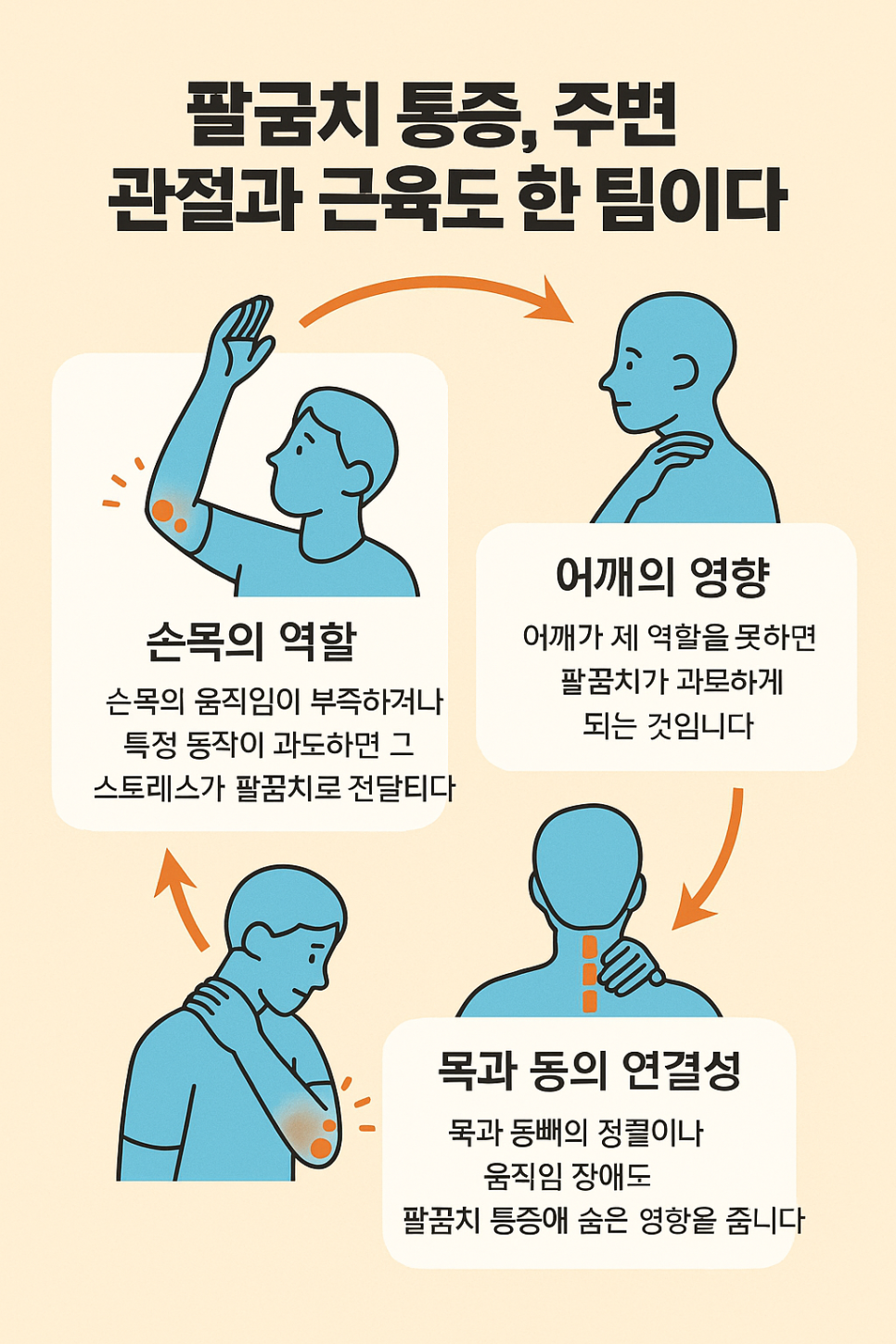
This is because the burden placed on the elbow greatly depends on the coordination of surrounding joints and muscles, such as the wrists, shoulders, neck, and back (spine). Just as other players are overworked when one player's condition is poor in team sports, multiple joints in our body also move like one team.
When a problem arises in one part, other parts easily become overloaded through compensation. To understand the cause of elbow pain, we must look at these surrounding kinetic chains together.
The Role of the Wrist
If wrist movement is deficient or if specific actions (e.g., repetitive wrist flexion/extension) are excessive, that stress is transferred to the elbow.
For example, when using a computer mouse for extended periods without moving the wrist sufficiently and working only with the elbow, stress accumulates on the tendon on the outside of the elbow. In fact, the cause of tennis elbow pain often originates from accumulated damage from wrist actions rather than the elbow itself.
The Influence of the Shoulder
The shoulder and shoulder blade (scapula) form the foundation of the entire arm. If the muscles around the shoulder (especially the rotator cuff) are weak or scapular stability declines, the muscles of the elbow and forearm work excessively instead during actions such as raising the arm or grasping objects.
This causes an overload on the wrist extensor muscles, which are small muscles, leading to micro-damage in the elbow tendon.
In other words, if the shoulder does not perform its role, the elbow becomes overworked.
The Connection to the Neck and Back
The alignment or movement impairment of the neck and thoracic spine also exerts a hidden influence on elbow pain. If the nerve pathway descending to the arm becomes hypersensitive due to nerve compression in the cervical spine or tension in the muscles around the neck, it can trigger or aggravate pain on the outside of the elbow.
Indeed, if elbow pain is reproduced when moving the neck in a specific direction, cervical nerve compression or referred pain should be suspected.
When rotational mobility of the thoracic spine decreases, the range of motion of the shoulder and arm is reduced, meaning the elbow or wrist joints must move that much more, which can increase the repetitive burden.
For example, when a person with a stiff lower back and poor trunk rotation performs a tennis backhand, they strike using only the elbow and wrist for power instead of the upper body, causing greater stress to be placed on the elbow.
The Kinetic Chain and Fascial Lines Connecting the Whole Body
In daily life, when we lift objects or exercise, we do not use our body in isolated parts; rather, the entire body coordinates as one. This is called the kinetic chain.
Simply put, it is the concept that the joints and muscles of our body are connected like a chain to transmit and disperse force. If one link in the chain is weak or does not function properly, the strength of the entire chain decreases.
For example, when lifting a heavy kettle:
- The back and spine muscles hold the body upright,
- The shoulder muscles lift the arm, and
- The forearm and wrist muscles grip the kettle.
If even one part fails to function properly in this process, the movement becomes awkward or an excessive strain is placed on other areas.
Understanding Fascial Lines
Fascia is a thin membrane that envelops and connects the muscles and organs of our body. The muscles that extend the wrist are connected by fascia through the outer part of the elbow all the way to the shoulder and neck areas.
That is, if a muscle or fascia around the wrist becomes tight and strained, the fascia along that path to the elbow, shoulder, and neck can also become taut, potentially leading to overall tension and imbalance.
For example, the wrist extensors → lateral epicondyle of the elbow → shoulder deltoid → upper back muscle (trapezius) → base of the neck are linked into a single fascial line involved in movement.
Repeated tension occurring in any one of these locations leads to a chain reaction of tension and overload in subsequent areas, ultimately affecting posture as well.
Reactive Muscle Activation
The theory of reactive muscle activation is the principle that if a certain muscle or joint fails to function properly, other muscles become excessively activated in an attempt to reflexively compensate for it.
For example, if a movement originally meant to be performed using the shoulders and back cannot be done properly because of weak shoulder muscles, the small muscles below the elbow become overly tense in an attempt to make up for the movement.
While such compensation may help briefly, in the long term, excessive strain accumulates on the relevant muscles and tendons, causing pain.
Links Among Major Muscles: From the Latissimus Dorsi to the Fingertips
To understand the treatment and prevention of tennis elbow, it is helpful to know which muscles are connected and how they act.
Latissimus Dorsi
This is a broad muscle that extends from the back, passes under the armpit, and attaches to the inner side of the arm bone (humerus). It acts significantly in pulling objects or moving the arm backward, thereby transmitting force from the torso to the arm.
The latissimus dorsi is connected to the fascia of the lower back, serving as a bridge connecting the torso, shoulder, and arm. If the latissimus dorsi is not used properly or lacks flexibility, the shoulder's range of motion decreases and the transmission of force through the arm becomes inefficient.
As a result, the small muscles of the elbow and forearm may have to bear more of that load.
Rotator Cuff
This is a collection of small muscles surrounding the shoulder joint (supraspinatus, infraspinatus, teres minor, subscapularis) that serve to stabilize and rotate the shoulder.
If rotator cuff strength is weak or shoulder stability decreases, the shoulder joint becomes unstable during actions such as lifting or swinging the arm, placing additional strain on the elbow.
In actual research, dysfunction of the rotator cuff has been frequently observed in patients with tennis elbow, such as showing reduced strength in shoulder external rotation muscles and a decreased range of rotation.
Wrist Extensor Muscle Group
This is a collection of muscles that extend the wrist and fingers, located on the back of the forearm and attached to the outer prominence of the elbow via a common tendon.
Among the wrist extensors, the tendon area of the extensor carpi radialis brevis (ECRB) in particular is the primary culprit causing pain in tennis elbow.
These muscles serve to stabilize the wrist so that it does not bend when bending the wrist backward (extension) and lifting objects.
For example, when gripping heavy objects or clenching a fist, the wrist extensor muscles provide the holding power to keep the wrist from flexing forward. Therefore, the very action of gripping tightly places a load on the wrist extensors.
Repetitive Strain Caused by Faulty Movement Patterns
When faulty postures or movement patterns persist, repetitive strain accumulates in the elbow, and the pain becomes chronic.
Our bodies are inherently designed to distribute force through efficient coordinated movement, but modern lifestyles and incorrect exercise habits frequently disrupt this mechanism.
Examples of problematic movement patterns include:
- A tennis swing performed using only the wrist and elbow without engaging the upper body
- The habit of bending the wrist while typing on a keyboard in a slouched posture
- The habit of lifting heavy objects using only the arms with insufficient shoulder range of motion
In such patterns, stress continues to concentrate on the so-called weak link (problem area). While it begins with mild pain at first, continuous repetition prevents tissues from sufficiently recovering, gradually leading even to degenerative changes and resulting in chronic pain.
The Importance of a Holistic Evaluation and Treatment Approach
To treat tennis elbow effectively, a perspective that views the whole body is necessary.
When evaluating a patient presenting with elbow pain, skilled physical therapists do not examine only the elbow, but broadly evaluate the wrist, shoulder, neck, and back.
Only by thoroughly examining muscle strength (grip strength) tests, fascial line tension, and the range of motion of the shoulder/cervical spine/thoracic spine can one identify the root cause of why the elbow tendon became injured.
Effective Treatment Approaches
Specific treatment and exercise prescription strategies:
1. Local Treatment of the Wrist and Elbow
- Use rest, ice packs, and, if necessary, anti-inflammatory treatment, taping, or braces to reduce pain at the inflamed area
- If pain is severe, initially immobilizing the wrist to relieve stress is also helpful
- Release tight forearm muscles through local muscle massage or soft tissue release
- Once pain subsides, build tendon durability through wrist extensor strengthening exercises
2. Improving Mobility of Surrounding Joints
- If wrist flexion/extension or pronation/supination movements are restricted, increase range through stretching and joint mobilization
- If shoulder joint flexibility and thoracic spine rotational mobility are decreased, perform stretching and mobility exercises to improve them
- In the case of forward head posture, correct alignment with chin-tuck exercises
3. Strengthening Muscle Strength and Stability
- Combine shoulder rotator cuff strengthening exercises with scapular stabilizing exercises
- Build the capacity to distribute forces transmitted to the arm across the torso through latissimus dorsi strengthening exercises
- Progressively strengthen forearm and wrist muscles as well, while learning correct muscle recruitment patterns
4. Retraining Movement Patterns and Education
- Adjust the work environment so excessive strain is not placed on the wrist
- Learn methods to lift heavy objects utilizing the legs and body weight rather than the elbow
- When participating in sports such as tennis, correct swing form under the guidance of a professional coach
Conclusion: The Elbow Is Connected to the Body
When tennis elbow is understood not simply as an isolated elbow problem, but as an issue of coordination among surrounding joints and the entire body, it becomes clear why it repeatedly recurs and how it should be prevented and treated.
When the elbow hurts, one must of course treat that area, but one should always ask oneself: "What caused this tendon to become overloaded?"
Observe whether the wrist is moving well, whether the shoulders and back are flexible and strong, and whether there are any issues with posture. Because our bodies are interconnected as one, one must remember that a disturbance in one area can manifest as pain in another.
Just as the saying goes, "A chain is only as strong as its weakest link," finding and strengthening the weak link in your body is the path to overcoming tennis elbow.
Through all-around management—ranging from wrist stretching to shoulder strengthening exercises and postural correction—elbow pain can be fundamentally resolved. When the elbow hurts, not looking only at the elbow is precisely the key to tennis elbow treatment.